
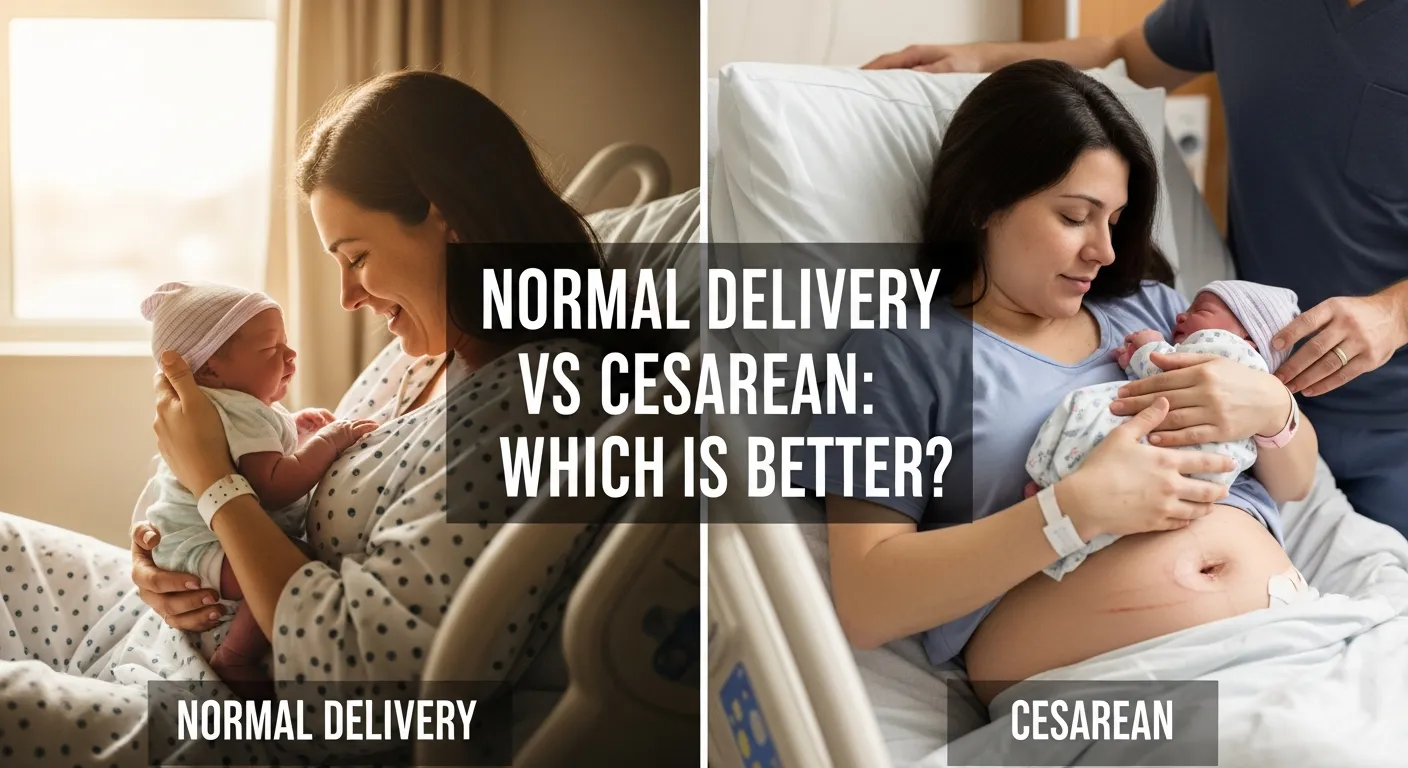
Confused between Normal Delivery and C-Section? Understand the difference between normal delivery and cesarean, pain levels, cost in India, and recovery time. Read the 2026 expert guide.
In India, the moment a woman gets pregnant, the "advice" starts pouring in. From your grandmother suggesting Ghee for a smooth birth to your neighbor warning you about C-section scars, the confusion is real. The debate of normal delivery or cesarean which is better is not just medical; it is emotional.
While Normal Delivery (Vaginal Birth) is nature's default method, Cesarean Delivery (C-Section) is a miracle of modern science that saves lives. But which one is right for you? Let’s break down the difference between normal delivery and cesarean with facts, not myths.
- At a Glance: Difference Between Normal Delivery and Cesarean
- What is Normal Delivery? (The Natural Process)
- What is Cesarean Delivery? (The Surgical Route)
- The Great Debate: What is More Painful C Section or Natural Birth?
- Cost Analysis: Normal vs C-Section in India (2026)
- Post-Delivery Recovery: The Indian Context
- Busting Myths: Cesarean Versus Normal Delivery
- Final Verdict: Which is Better Normal Delivery or C Section?
At a Glance: Difference Between Normal Delivery and Cesarean
If you are in a hurry, here is the quick comparison table designed to give you clarity immediately. (Note: This table is optimized for Google Snippets).
| Feature | Normal Delivery (Vaginal Birth) | Cesarean Delivery (C-Section) |
|---|---|---|
| Definition | Baby is born through the birth canal (vagina) naturally. | Baby is delivered via a surgical incision in the abdomen and uterus. |
| Pain Level | High pain during labor; minimal pain after delivery. | No pain during delivery (anesthesia); significant pain during recovery. |
| Recovery Time | Fast. You can walk within hours. Full recovery in 2-4 weeks. | Slow. Bed rest required initially. Full recovery takes 6-8 weeks. |
| Hospital Stay | 1-2 Days. | 3-5 Days. |
| Baby's Immunity | High. Baby receives beneficial bacteria from the birth canal. | Moderate. Baby misses out on vaginal microbiome (can be managed with breastfeeding). |
| Cost in India | Lower (₹25,000 - ₹80,000 approx). | Higher (₹50,000 - ₹2 Lakhs approx). |
What is Normal Delivery? (The Natural Process)
A Normal Delivery is when the baby is born through the vagina. It is a process driven by the mother's hormones (Oxytocin) and uterine contractions. In medical terms, it is the most recommended method unless there is a complication.
Stages of Normal Delivery
- Labor (The Painful Part): The cervix dilates from 0 cm to 10 cm. This can take 8 to 18 hours for first-time moms.
- Pushing & Birth: The mother pushes the baby out through the birth canal.
- Placenta Delivery: After the baby is born, the placenta is pushed out.
Why Doctors Prefer Normal Delivery? (The Pros)
When asking which is better normal delivery or c section, doctors usually vote for Normal Delivery for low-risk pregnancies because:
- Gut Health for Baby: As the baby passes through the vaginal canal, they ingest good bacteria. According to the World Health Organization (WHO), this exposure helps build the baby's immune system and reduces the risk of asthma and allergies later in life.
- Natural Lung Cleaning: The pressure of the birth canal squeezes fluid out of the baby's lungs, helping them breathe better immediately after birth.
- Quick Recovery for Mom: You can hold your baby, breastfeed, and even walk to the washroom within a few hours. No surgical wounds to heal.
- Future Pregnancies: It is safer for future births as there is no scar on the uterus.
The Challenges (The Cons)
- Unpredictable Labor: You cannot schedule it. Labor can last for 24 hours or more.
- Perineal Tearing: The skin between the vagina and anus might tear, requiring stitches.
- Risk of Incontinence: Some women face temporary bladder control issues post-birth.
What is Cesarean Delivery? (The Surgical Route)
A Cesarean delivery or C-section delivery is a major surgery where an incision is made in the mother's abdomen and uterus to lift the baby out. In 2026, C-sections have become very safe and common, especially in urban India.
Types of C-Sections
- Planned (Elective) C-Section: Decided in advance due to complications like Placenta Previa, Twins, or the baby being in a breech position (legs down).
- Emergency C-Section: Done during labor if the baby’s heartbeat drops or labor stops progressing.
Why Choose C-Section? (The Pros)
- Life-Saving: In high-risk cases (high BP, cord around neck), this is the safest option for baby and mother.
- Convenience: You know the exact date and time of birth (Planned C-section).
- No Labor Pain: You bypass the grueling hours of contractions.
The Challenges (The Cons)
- Longer Recovery: It is a major surgery. You cannot lift heavy weights or do household chores for at least 6 weeks.
- Surgical Risks: Risk of infection, blood loss, or clots is higher than normal delivery.
- Impact on Future Births: Once a C-section, the next birth often becomes a C-section (though VBAC - Vaginal Birth After Cesarean is possible).
The Great Debate: What is More Painful C Section or Natural Birth?
This is the most searched question: what is more painful c section or natural birth? The answer lies in timing.
The Pain Timeline
- Normal Delivery:
Before Birth: 10/10 Pain (Labor contractions).
During Birth: 10/10 Pain (Pushing).
After Birth: 2/10 Pain (Soreness, stitches healing).
Pain ends quickly. - C-Section Delivery:
Before Birth: 0/10 Pain (Anesthesia).
During Birth: 0/10 Pain (You feel only tugging).
After Birth: 8/10 Pain (Surgical wound, difficulty walking/laughing).
Pain lasts for weeks.
Verdict: Normal delivery is a sprint (intense but short pain). C-section is a marathon (no pain initially, but long-term discomfort).
Cost Analysis: Normal vs C-Section in India (2026)
Financial planning is crucial for Indian families. The cost varies significantly between Tier-1 (Delhi, Mumbai, Bangalore) and Tier-2 cities.
| City Type | Normal Delivery Cost (Approx) | C-Section Cost (Approx) |
|---|---|---|
| Govt Hospitals | Free / ₹2,000 | Free / ₹5,000 |
| Tier 2 Cities (Lucknow, Jaipur) | ₹25,000 - ₹45,000 | ₹40,000 - ₹70,000 |
| Tier 1 Cities (Private/Luxury) | ₹50,000 - ₹1,00,000 | ₹80,000 - ₹2,50,000 |
Note: Insurance companies in India usually have a waiting period of 2-4 years for maternity cover. Check your policy regarding "C-section limits" as some cap the claim amount.
Post-Delivery Recovery: The Indian Context
Whether you have a normal or c section delivery, the first 40 days (Confinement Period) are critical in Indian culture.
Recovery After Normal Delivery
- Movement: Start walking slowly the same day.
- Diet: You can eat Gond ke Laddu, Ajwain water, and Ghee in moderation immediately to regain strength.
- Care: Sitz baths (sitting in warm water) help heal vaginal stitches.
Recovery After C-Section
- Movement: Walking is painful but necessary to prevent blood clots. Avoid climbing stairs.
- Diet: Avoid heavy Ghee or gas-inducing foods (like Rajma/Chole) for the first 2 weeks as bloating hurts the stitches. Focus on light, fiber-rich khichdi.
- Stitch Care: Keep the incision dry. Do not apply creams without a doctor's advice.
Busting Myths: Cesarean Versus Normal Delivery
Myth 1: "C-Section is the easy way out."
Fact: Absolutely not. It is major abdominal surgery. Mothers who undergo C-sections face a tougher recovery while caring for a newborn. It requires immense strength.
Myth 2: "Normal Delivery spoils your figure/hips forever."
Fact: The hips widen during pregnancy, not just delivery. With proper postnatal exercises and diet, your body can return to its pre-pregnancy shape.
Myth 3: "Once a C-Section, Always a C-Section."
Fact: Not true. VBAC (Vaginal Birth After Cesarean) is possible in many cases if the gap between pregnancies is adequate and the scar has healed well.
Final Verdict: Which is Better Normal Delivery or C Section?
So, which delivery is better normal or c section? Here is the honest truth:
- If your pregnancy is healthy, the baby is head-down, and you have no complications -> Normal Delivery is Best. It is natural, helps the baby's immunity, and lets you recover faster.
- If there is a medical risk to you or the baby -> C-Section is Best. In these cases, a C-section is not a "choice" but a life-saving necessity.
Don't let societal pressure dictate your birth plan. Whether you give birth via the vaginal canal or an incision, you are a mother, and that makes you a warrior. Trust your Obstetrician-Gynecologist (OB-GYN) to make the safest decision for you.